Has digital transformation devalued the worth of work ?

A bit of context
On November 7, I was invited by my company Ekino to attend the annual event BDX I/O which gathers a good part of the tech domain in France south west town of Bordeaux. It’s good to know that this meetup is made possible by a small team of volunteers who works hard to provide us the best day possible, with good food, drinks, interesting conferences, etc.
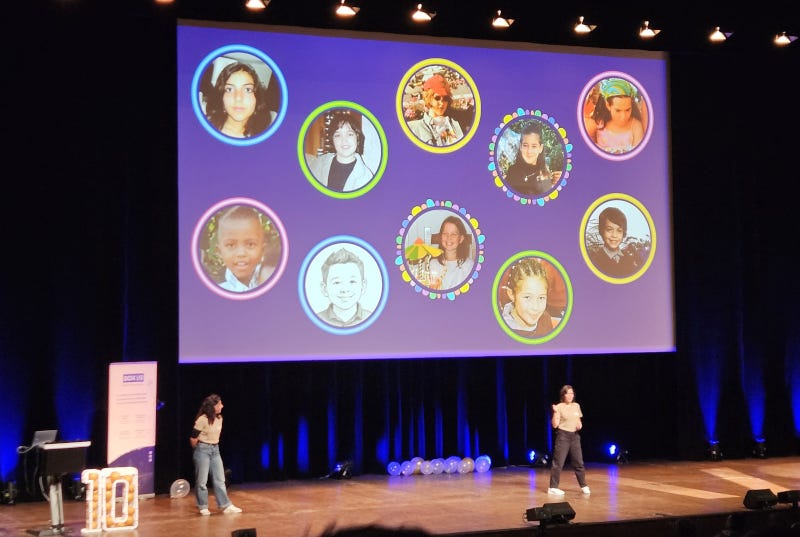
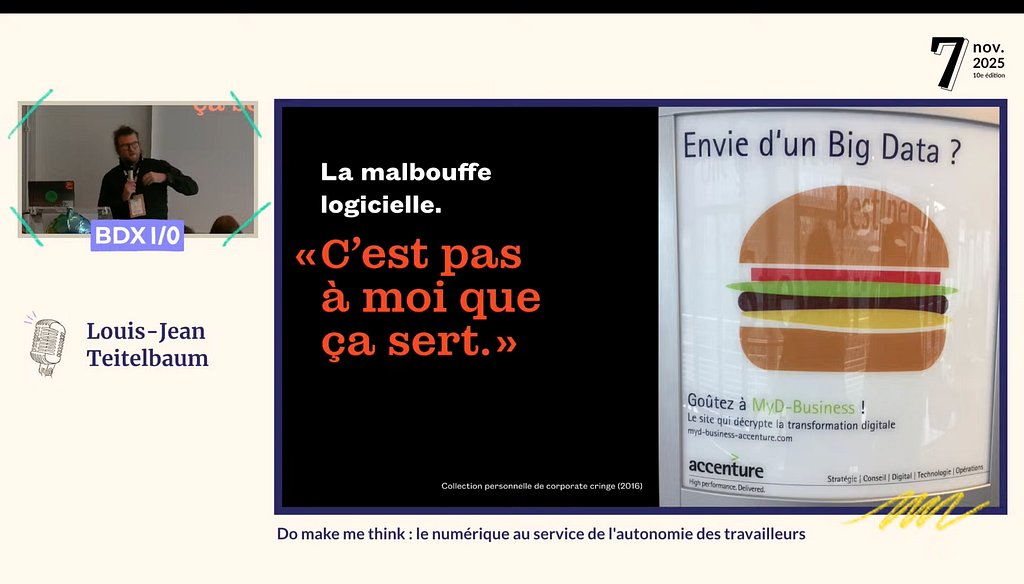
I’m not here to cover the whole program, but one talk really made an impression on me. The French original title was: “Do make me think : le numérique au service de l’autonomie des travailleurs” or “Do make me think: digital technology promoting employee’s autonomy”. In a 45-minute talk, Louis-Jean Teitelbaum (UX/UI Designer) outlines how job digitalisation has created an overwhelming administrative burden for many workers. Despite software companies’ promises of simplification and efficiency, design and tech fields have unintentionally played a role in diminishing workers’ expertise, compelling them to spend more and more time on data-entry tasks.
Louis-Jean introduced his talk by mentioning a web app he worked on with his team. It’s called “Carnet de Bord” and it aims to help people supervising social workers. This application was part of the beta.gouv.fr, where you can find digital public services that may be released in the future. After 4 years of service, it was purposely discontinued as they ended up finding that it was more of a burden than a gain. It’s quite a shame because UX/UI team really dug deep to understand the users need and provide the data that would help them work more efficiently.
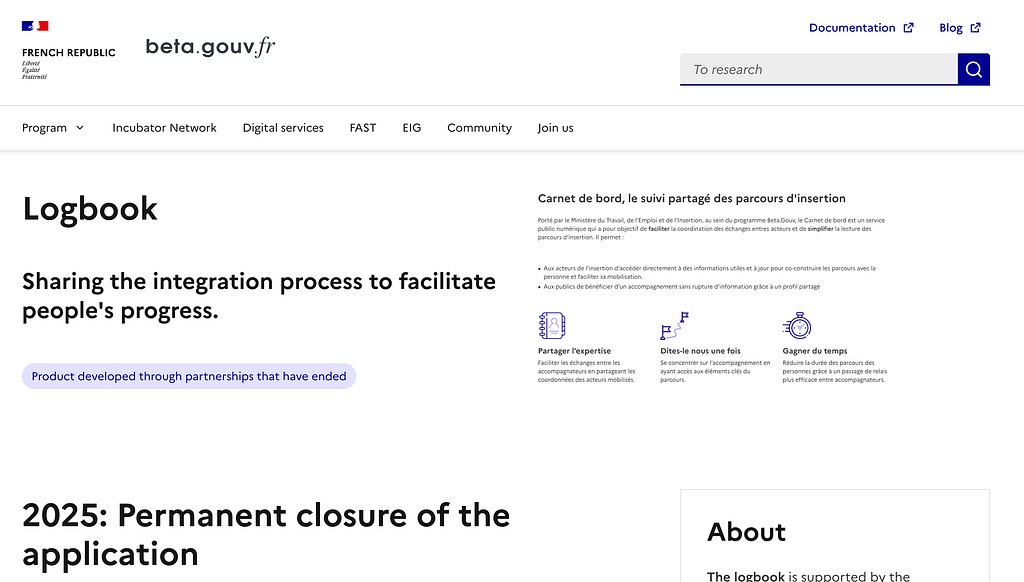
The hard truth about the project they’ve been working on…
What they discovered is that local mission organizations had already been using proprietary software (like Notion, Word, etc.) to support social workers in their efforts. Therefore, the arrival of this new tool felt more like, “This is not for us; this is just to prove to our superiors that we are doing our job correctly.” The tool became a constraint; data entered into it were rarely consulted, effectively turning the platform into a “write-only” system.
To make a metaphor with a real life example, the speaker mentioned when he bought a beef steak at the supermarket which only contains 75% real meat, completed by 25% of soja protein. In the same way, the end user does not consume the whole purpose of the tool.
Another scary fact is that people using the tool took one day out of their working week (friday for instance) only to input data on “Carnet de bord”. As a result, general feedback they received usually were: the tool was well made but people hated using it. Of course, they had an active user base because it was mandatory to throw data in it. The team who originally created the project had to argue a little to shut it down, because some governmental instances found useful to have something that allowed them to keep track of people’s work.
Beyond the presentation, I felt the need to explore the topic further and eventually found this article. MIT’s researcher David Autor and Neil Thompson write automation that automation sometimes did not kill expertise in jobs, even made their wage rise up. They took the example of bookkeepers and accounting clerks, their number was reduced by a third between 1980 and 2018, but their real hourly wages rose by nearly 40%.
Jobs can either become more or less numerous, depending on what types of automation happen to the job, if the thing that gets automated is the easiest task, that leads to a narrowing of the pool of people that do it. But they are paid more.
They conducted a sweeping study about U.S occupations, and ended up finding two paths:
- Automation has raised wages and reduced employment in occupations where it eliminated low-skill tasks.
- Automation lowered wages and increased employment in occupations where it eliminated expert tasks.
As we can see, while jobs may be automated, they can nevertheless suffer from the digital solutions they use on a daily basis.
Bad software can really hurt people lives. Following this article, a bug in the UK Post office’s Horizon software reported that accounts under the employees’ control were missing money. The Post Office prosecuted postmasters for missing funds, even though there was evidence that its own computer system could be at fault/to blame.
People lost jobs, families, and one woman was sent to prison while pregnant. One man committed suicide after the system showed his account was missing £100,000.
The Post Office started offering compensation and says that it will replace the Horizon system with a cloud-based solution, but still the harm was done.
Going back to the BDX I/O presentation of Louis-Jean, he showed us examples where the “fun” part of a job was given to the machine and the annoying part left to human. Imagine going for a check-up at the doctor’s and seeing him use Chat-Gpt to diagnose you while writing the prescription by hand. Seems completely crazy ? Well in some business domains, it is already happening.
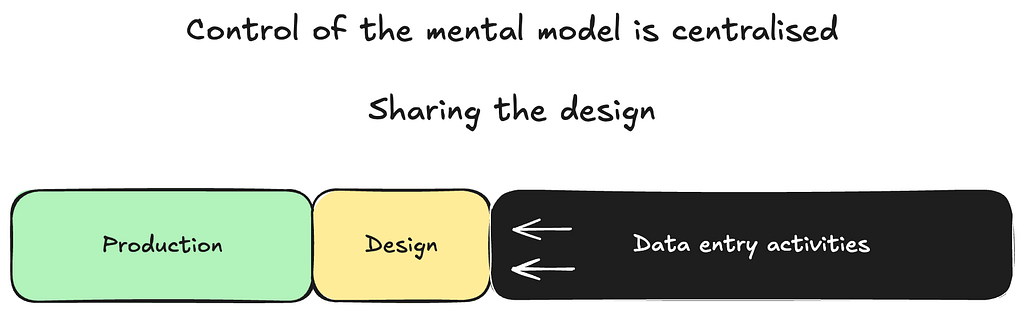
Sometimes the problem is not that modern tools requires more input from the user,It’s moving out the human from the workspace design process, when he sets up his own environment, his own tools to work with. Progressively, the job becomes more boring and your qualification decreases.

A way to reverse what work has become
While our productivity improved over the decades, we ended up making meaningful work dull.
Have you heard of Douglas Engelbart ? His most famous invention was the computer mouse. One of his moto was to improve human capacity. It’s often said that he wasn’t fond of easy-to-use computer and sad to notice smart people using high-end machines to become form fillers.
We could start by reducing data entry task for more read only software, also giving priority to metadata. In the example of social services, the software development team could easily connect APIs to recover the work background of an individual, helping in this way the supervisor in charge of his case. Encouraging direct contact between people is also positive, as it reduces machine control over real social interactions. In the example of “Carnet de bord”, contact form was taken out in profit of telephone contact details.
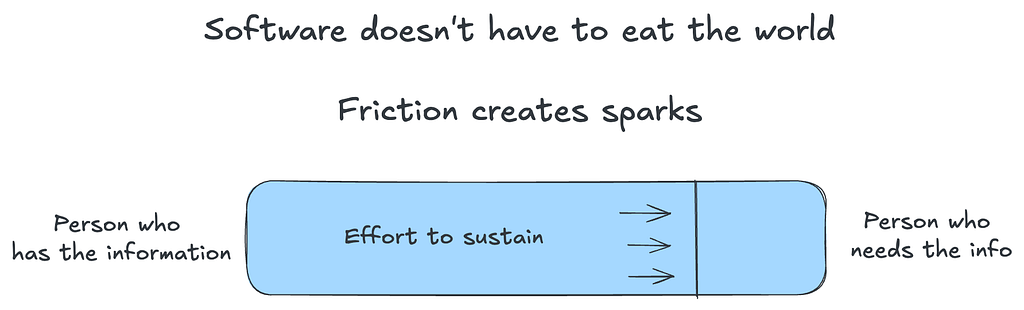
We have also to categorize tools that we use on a daily basis: ones that let us express ourselves compared to others that guide the user along a predefined path. For instance, Visual Studio Code is an expressive tool, I can code whatever I want with it, the tool is not going to press me to use JavaScript over Rust for instance. On the contrary, the government website where I declare my taxes forces you to follow a path to ensure that you comply with administrative standards.
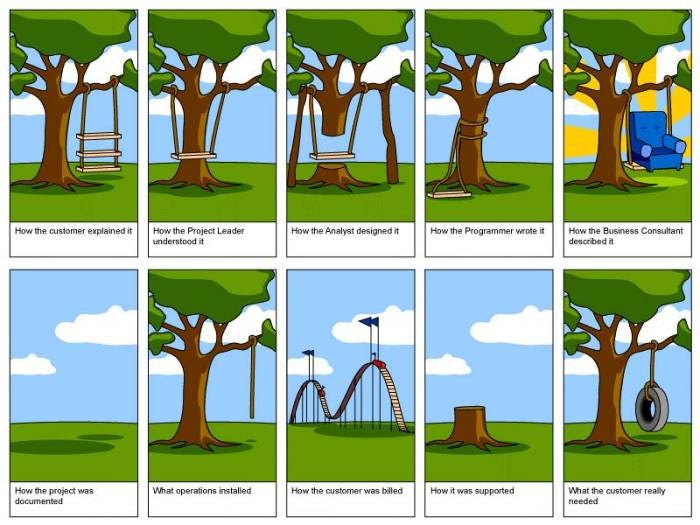
It is mentioned in the presentation the importance of conducting workshops with the people who are going to use the digital product. Taking time to understand the needs is vital to develop the right tool. As said in this article, translating client needs into a language that fosters mutual understanding is a pivotal milestone.
Have LLMs changed the dynamic of work ?
The end of the presentation focuses on LLMs and how it reinvents work at office. He refers to these machines as ‘boss tools’: an employer can use them to replace an expert with a machine and hire a less qualified worker instead. On the other hand, you have “worker tools”, like media generation through AI. If you’re an illustrator and lacks skills at 3d modelizing, maybe machines can help you create your own 3d model on which you can apply your own creativity. In that way, machine enhances what human can achieve.

AI tools emergence open the path for end user programming. Us, designers and programmers, could leave the door open for our user to express itself in our tool. For instance, scripts and macros added to extend or automate office productivity suites and graphics applications. The speaker ended up on that note:
Say goodybye to “User at the centre”, center on work instead
Personal note
I really enjoyed the subject as it reflects how we on a global scale, are using tool on a daily basis. As some offer to us a world of creativity, like writing, coding, drawing, etc. But on another side, some tools are just meant to write data that will rarely be consulted, and takes up a lot of time and energy off the person. Let’s hope for a better future for all workers in the world overwhelmed with painful data entry tasks.
On a personal note, this is my final year of my master’s degree in computer science, and I’m also working as a frontend developer at my company. I hope for the future that I will not end up coding something that make people’s lives a nightmare.
Bonus: What is “enshittification” ?
https://en.wikipedia.org/wiki/Enshittification
Introduced by Cory Doctorow in 2022, this phenomenon is described as a linear process in four steps:
- First, tech companies provide services to customers that become progressively dependant.
- They use their user base to satisfy businesses needs, by providing users data to their suppliers, at lost.
- In the third phase, platforms take advantage of these two categories of customers, who have become captive, to serve their own interests: surpluses are distributed to shareholders. They no longer have any reason to offer good quality service.
- Companies eventually disappear in the final phase, when the costs of captive customers leaving cease to be prohibitive, for example if an alternative emerges.
Let’s dive into real life examples: AirBnB is accused of contributing to the commodification of housing, also applying very high commissions, which can make rental prices comparable to — or even higher than — hotel room rates.
Uber initially gained market share by bypassing local regulations and subsidizing rides, but once it secured a duopoly, it implemented surge pricing and practices that increasingly disadvantaged drivers. A 2025 study, “The Enshittification of Work: Platform Decay and Labour Conditions in the Gig Economy,” shows that gig platforms like Uber follow an enshittification-like pattern — shifting costs to workers, altering features to increase effort, and manipulating markets — ultimately degrading working conditions despite early promises of flexibility.
Public pressure can sometimes force companies to roll back aspects of enshittification. On March 25th, 2025, following widespread criticism of its Digital Rights Management approach, Universal Audio relaxed its iLok DRM requirements. The company removed the need for constant online verification and switched to machine-based or USB-dongle authorization. They also increased the number of allowed activations per license from two to three. Users welcomed the update, noting they were “glad to see UA is listening.”
Has digital transformation devalued the worth of work ? was originally published in ekino-france on Medium, where people are continuing the conversation by highlighting and responding to this story.
Articles



Un projet ?
Parlez-nous de vous, de vos projets, de vos ambitions, de vos enjeux, et construisons ensemble des solutions concrètes qui contribuent à votre transformation.