Too many typos, not enough time — Until AI changed everything
I’ve been running a personal website for quite some time now, and from the very beginning, I wanted to have a technical blog where I could publish articles about the things I felt like sharing. And as my colleagues know, I usually have a lot to say!
I already talked about how I revamped my personal website (and some more) in this article.
My first posts were tutorials — one on using Subversion, another on installing and configuring a Debian server from OVH — and then… not much else. It wasn’t for lack of ideas, but once I joined ekino and wrote my first article as an employee, things got complicated.
I’m one of those people who makes too many mistakes when writing, which means I spend way too much time proofreading and fixing everything. That process feels slow and frustrating, and so I let the whole blogging idea slide for a long while. I still contributed to a few conference reports and other small pieces, but nothing regular.
Then came the rise of AI. With powerful tools that make correcting and polishing text effortless, the desire to write came back. So here I am, ready to share my writing process — and especially how I plan to keep publishing articles on Medium to get my ideas out there (I actually use the same workflow to prepare my talk proposals — at least for the last three I’ve done.)
Step 1 — The Idea
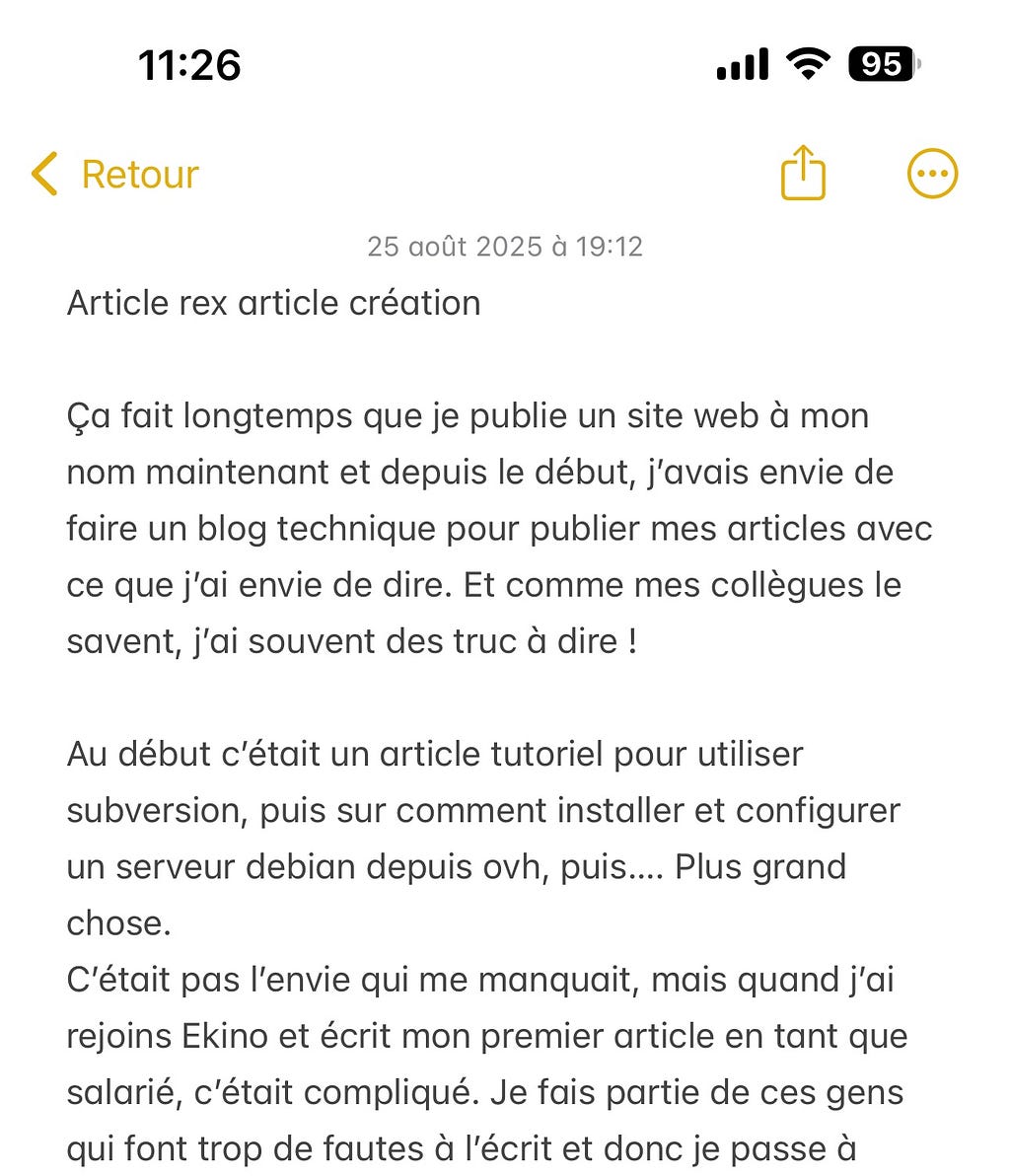
I’ve made it a habit to start writing articles or talk proposals as soon as an idea pops into my head and feels motivating enough. Most of the time, these ideas strike me around 2 a.m., after four hours of failing to fall asleep and realizing that the 7 a.m. alarm is going to hurt. Because let’s be honest — when I try to think about nothing, my brain starts thinking about everything!
That’s usually when I grab my phone, open a notes app, and start jotting down whatever comes to mind. The notes are messy: bullet points, half-sentences, random fragments. I don’t bother with sentence structure, metaphors, or clever wording — I just focus on capturing the idea and the thread I want to follow later.
Note to myself: keep a notebook and pen on the nightstand. That way I won’t have to stare at a screen and wake myself up even more next time.
Step 2 — Reviewing My Notes
This step is a bit chaotic, to be honest. I try to make sense, with a clear head, of the ideas I scribbled down the night before. It’s not always easy, but the goal here is to start shaping a structure — a rough outline that gives the article a clear and coherent flow.
I look for a logical thread, grouping related ideas into sections or sub-sections, but I still keep the raw writing style. At this point, I’m not aiming for polished text — the only objective is to end up with coherent blocks of content that serve my overall story.
Step 3 — Enter the AI
I use AI as a writing companion — it helps me structure my sentences, link them together with the right words, fix spelling and grammar, but most importantly, keep my own voice. That’s one of my golden rules when prompting: I don’t want the AI to replace my style.
I experimented with several prompts before finding one that gave me results I liked. Once I’m ready, I open the AI of my choice (for me, that’s ChatGPT) in a fresh session and give it my “magic prompt.” Then it’s a back-and-forth process: I feed it one subsection at a time, let it work, and review the output.
You are an AI specialized in content writing for technical blogs, especially IT-related topics.
I will provide you with raw material in the form of notes, bullet points, drafts, or full written text.
Your goal is to:
- Reshape and refine the content.
- Fix any typos, grammar, or style issues.
- Expand ideas where needed (e.g., add examples, explanations, or references).
- Ensure the text flows smoothly and is enjoyable to read, as if it were published on Medium.

**Golden Rule**: Keep the author’s voice. Preserve their tone and style—you must not erase or replace it, only enhance it.

The user will provide the content chapter by chapter.
I never give the AI my full article all at once. If I don’t like the direction it takes, I prefer to adjust along the way. That way, I keep control over the narrative instead of ending up with a generic piece.
Step 4 — Final Review & Polish
Now comes the technical part. I open two files side by side in my IDE: my structured raw notes on one side, and the AI’s output on the other. With a split screen, I go through section by section, making sure all my ideas have been faithfully captured.

I double-check that the writing still sounds like me, that nothing has been added out of nowhere, and above all — no random emojis sprinkled everywhere! Once the text feels right, it’s time for decoration.
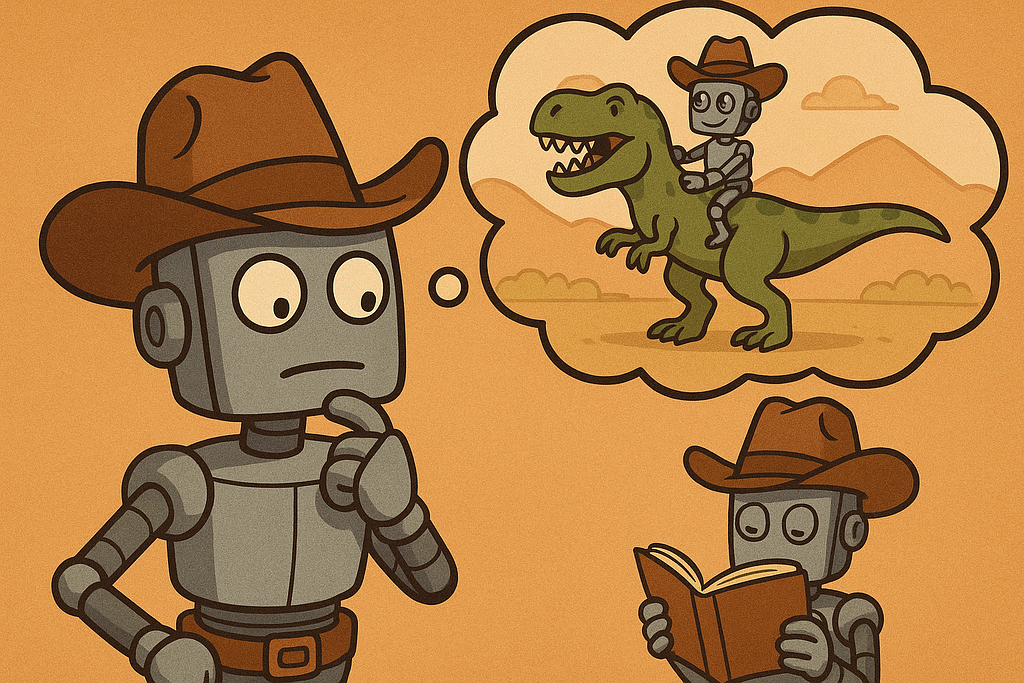
That’s when I hunt for images: stock photos, royalty-free visuals, screenshots… and if I can’t find anything that fits, I ask the AI to generate something fun (usually a quirky robot illustration)…
…as long as I don’t hit usage limits, of course.
Bonus!
This last step is really the cherry on top, and it also shows how much we care about quality at ekino. Once an article is written, we usually send it to a few peers for a first round of technical review. This helps validate that the technical explanations are accurate and that the overall flow makes sense.
For me, this is a real quality stamp: it’s not just about proofreading, but about bringing another perspective. Reviewers might suggest key points to add, highlight where the reasoning could go deeper, or propose another angle that strengthens the article.
Once the article passes this step, it goes to our Medium expert for a final review. It ensures overall consistency, tone, and internal linking with other articles, and also manages the publication calendar. Thanks to this process, everyone at ekino gets the chance to express themselves, be published, and contribute to our shared voice.
Conclusion: I’ll definitely keep using this process, because I genuinely enjoy writing and sharing my experiences here. I’m not aiming for the reach of someone like Korben, but it helps me grow my skills and feed my curiosity.
P.S.: This is actually the first article I didn’t write at 2 a.m. but comfortably sitting on my terrace at 7 p.m., with a lightly hopped beverage in hand. Hopefully the subject is still fun for you to read!
Too many typos, not enough time — Until AI changed everything was originally published in ekino-france on Medium, where people are continuing the conversation by highlighting and responding to this story.
Articles



Un projet ?
Parlez-nous de vous, de vos projets, de vos ambitions, de vos enjeux, et construisons ensemble des solutions concrètes qui contribuent à votre transformation.